


CO2 Footprint of Wine
The Fact Check
Anyone who occasionally drinks wine is familiar with a wide variety of European wines. No wonder, since they are right around the corner, and "local consumption" or "no food waste" are the new trends in society. Because everyone wants to do something good for the planet and become as green as possible. Unfortunately, the omnipresent reputation of European wines, when looking at the wine lists of Swiss restaurateurs, does not really help. This is because the CO2 emissions for transporting these wines, from the country of origin to Switzerland, are sometimes much higher than, for example, from South Africa.
We at KapWeine have done our research and are laying out the facts!
Europe vs. Overseas, or – Clean Guys vs. Underdogs
But let's start from the beginning and compare two realistic examples. For Europe, one of Spain's most famous wine regions, "Ribera del Duero", will participate. This wine-growing region is located approximately 170 driving kilometers north of Madrid and about 1,500 driving kilometers from Zurich.
The challenger from overseas is in South Africa, more precisely from the renowned wine-growing region "Stellenbosch". This is located approximately 40 driving kilometers from the freight port of Cape Town "Transnet Port Terminals Administration" and about 9,050 air kilometers from Wädenswil/Zurich. The exact mileage of the freight will be calculated together below.
What does a typical wine delivery look like?
A dealer or importer (like KapWeine) orders their wines from abroad. The wine delivery must therefore be transported from A to B, whereby time, costs, and CO2 footprint should be kept within reasonable limits. According to current international logistics standards, a 75cl wine bottle comes in a 6-pack and stacked as a Euro pallet, which is loaded in larger quantities into containers. Most pallets are loaded with 480 or even 600 wines. Depending on the volume to be shipped, the optimum for the maximum delivery quantity in a container must be found. The aim is to use as much area and space as possible without exceeding the total weight of the permissible container weight.
Now you are probably wondering how many bottles of wine can fit in a container and what the limit is? But let's not make life more complicated than it is and stick to a simple calculation example with the following values.
One wine delivery corresponds to:
- 40” container with 12.1 loading meters
- 24.5 tons weight
- approx. 26 Euro pallets
- approx. 15,000 wine bottles à 75cl
Calculation of the CO2 footprint for both wine regions
Thanks to modern tools, we are very well able to calculate CO2 values for a multitude of products today. Thus, a CO2 traffic light, which provides us with information about the conditions, is increasingly found in the food sector. Using the website carboncare.org, we will now calculate the two wine opponents against each other. Do you already have an idea who the winner will be?
Spain – Ribera del Duero
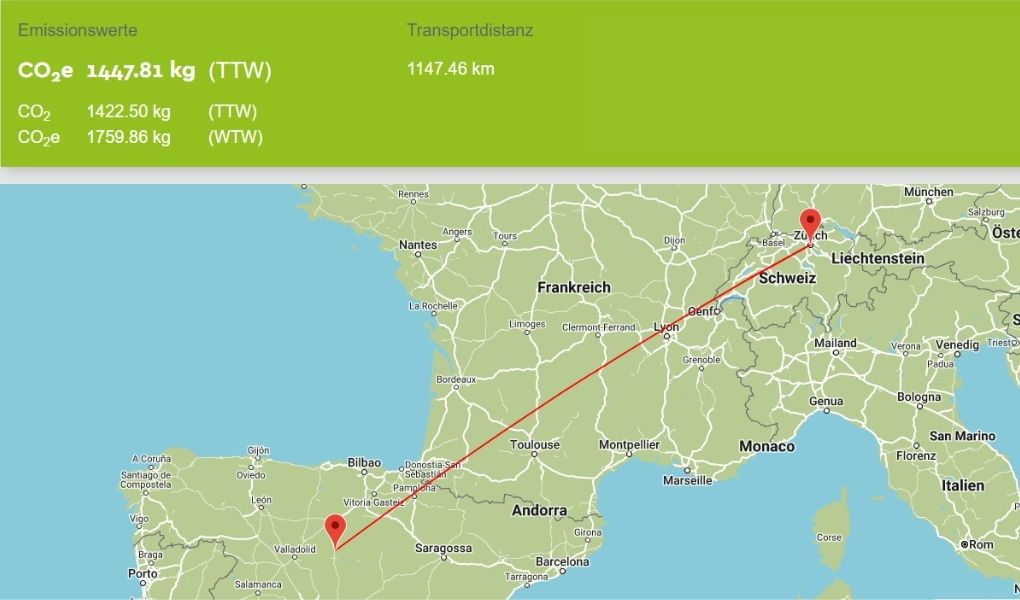
Starting with our Spanish wine-growing region "Ribera del Duero", a 40" container with 24.5 tons is loaded onto a truck and transported to Zurich city. As can be seen in the following screenshot, the air distance of 1147.46 kilometers is used as a basis, with CO2 emission values at a proud 1447.81 kg (TTW = Tank to Wheel), which refers to the vehicle, i.e., the truck. However, we are interested in the value of 1759.86 kg (WTW = Well to Wheel), which means that all steps, including fuel extraction, have been taken into account.
Now we consider the missing driving kilometers compared to the air distance. Initially, we calculated approximately 1,500 driving kilometers. This means that 352.2 driving kilometers are still missing from the calculation. In a simple rule of three, this means that we still have to add 540.69 kg of CO2 (WTW). This brings us to a total CO2 of 2300.551 kg (WTW). This corresponds to 0.153 kg CO2 per bottle of wine.
2300.551 kg CO2 total (WTW)
0.153 kg CO2 per 75cl bottle of wine
Well, this was the easy part of our comparison. I hope you all kept up, because it gets a bit more complex.
South Africa – Stellenbosch
What was still easy to calculate for European standards now becomes more complex due to the greater distance and the multi-layered transport route. And if you're thinking that air kilometers were mentioned earlier in the article – no, we are not South American drug lords from the 80s who would dare to fly in the wines, let alone bear the costs. South Africa is already green, organic, and sustainable in production, and we at KapWeine stick to these values! But let's get back to the transport route and the CO2 footprint.
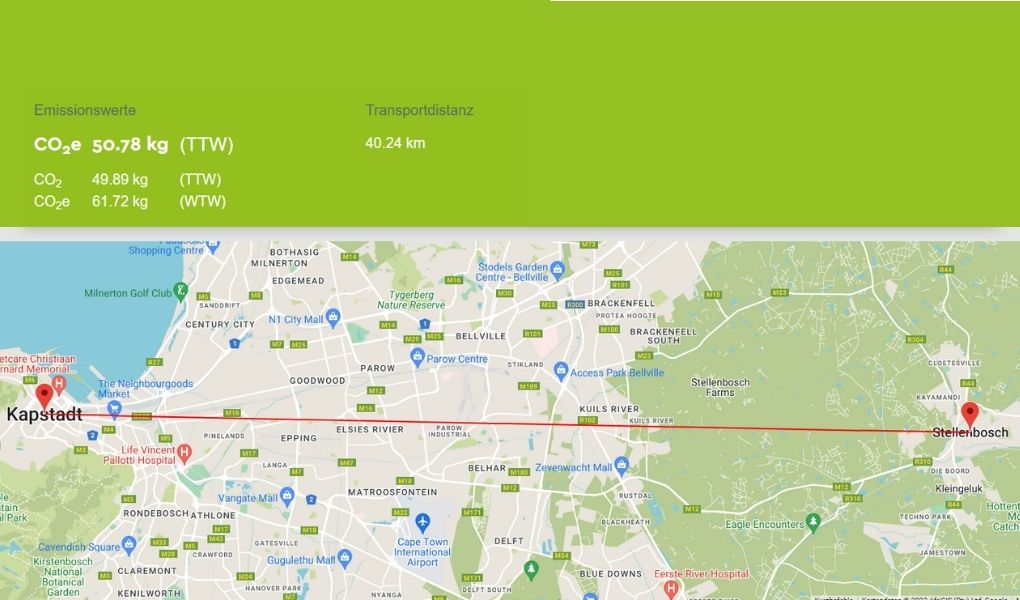
Our Stellenbosch container travels the first 40 kilometers by truck to the port in Cape Town. This corresponds to 50.78kg (TTW) and 61.72kg (WTW).
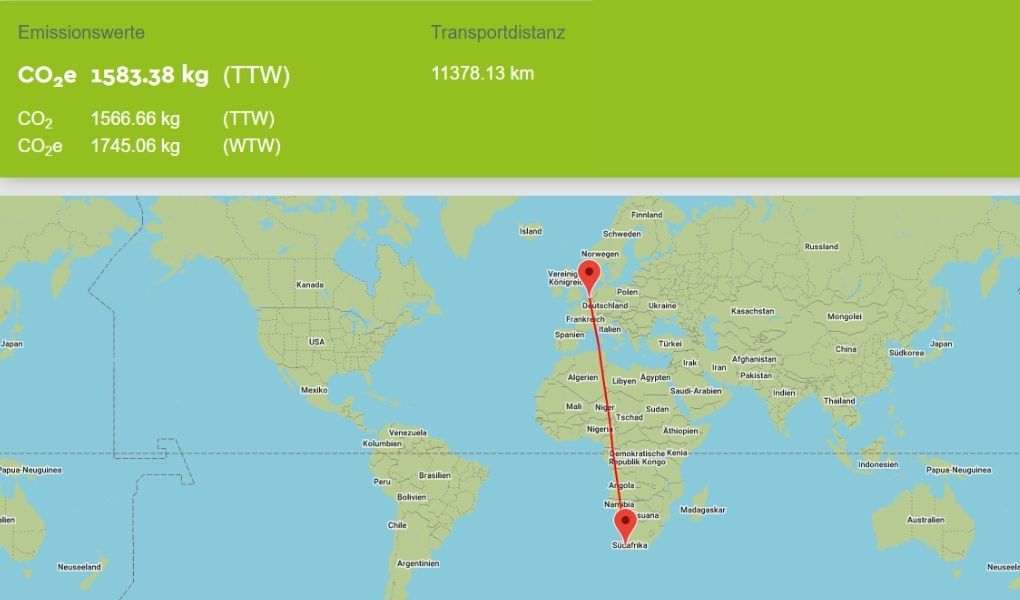
As the second mode of transport, the journey leads from Cape Town via MSC container ship to Antwerp (Belgium) to the European freight port. This corresponds to a distance of 11,378.13 nautical kilometers and accounts for 1583.38 kg (TTW), or 1,745.06 (WTW). The crossing takes approximately 3 weeks.
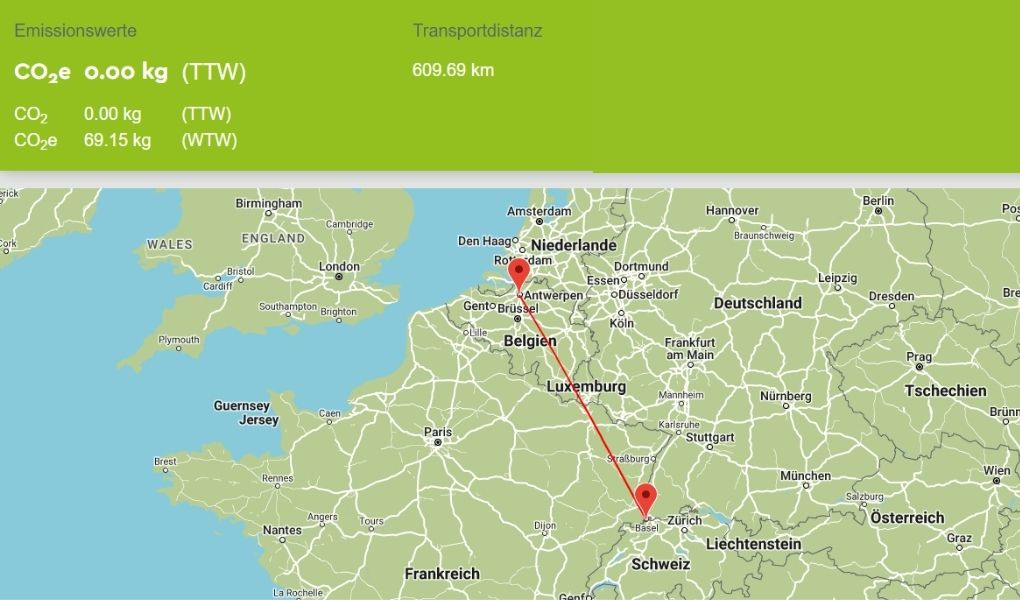
The third stage comprises the freight train from Antwerp (Belgium) to Basel city. This corresponds to a distance of 609.69 kilometers, whereby the CO2 footprint dwindles. 0.00 kg (TTW) and 69.15 kg (WTW). Here we see once again that it doesn't get greener than by train!
In the fourth and final leg, our container is loaded onto a truck again, so that it is transported from Basel to Wädenswil. Here we have a distance of 88.96 kilometers with 112.24 kg (TTW), or 136.43 kg (WTW).
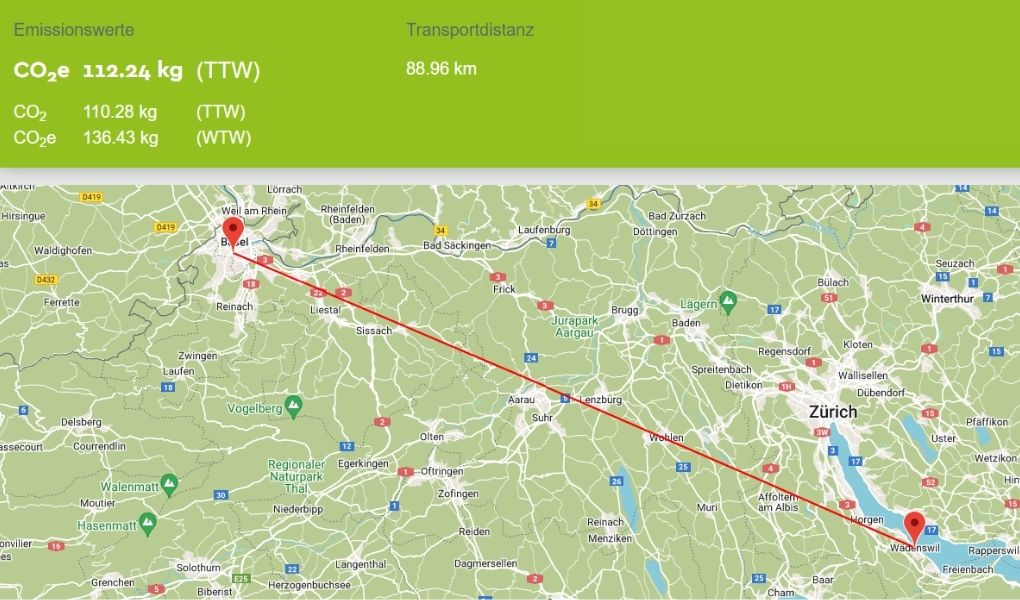
If we summarize all WTW values, we get a CO2 emission of 2,012.360 kg (WTW), which corresponds to 0.134kg CO2 (WTW) per bottle of wine. Would you have thought that?
2012.360 kg CO2 total (WTW)
0.134 kg CO2 per 75cl bottle of wine
Wine from South Africa - Hooray! Europe - Boo!
Not everything that comes from the region, or from Europe, is necessarily greener! Products from overseas can also compete well and even have a better CO2 balance.
A bottle of wine from Stellenbosch (South Africa) requires 90% less CO2 than from Ribera del Duero (Spain)
Considering that our South African wine has traveled over 10,000 kilometers further, this is an astonishing achievement. Here again for comparison.
Ribera del Duero → Zurich
- 1,500 kilometers
- 2,300.551 kg CO2 (WTW)
- 0.153 kg CO2 (WTW) per bottle of wine
- 1.533 kg CO2 (WTW) per kilometer
Stellenbosch → Wädenswil
- 12,116.78 kilometers
- 2,012.360 kg CO2 (WTW)
- 0.134 kg CO2 (WTW) per bottle of wine
- 0.166 kg CO2 (WTW) per kilometer
So we can appeal to everyone to also look behind the scenes. Because South Africa may be far away, but it clearly has a better balance than many wines from Europe.
Why are distant, unknown, and especially the African continent, spoken of badly?
Unfortunately, people tend to be skeptical of the unknown, new, and foreign. The unfamiliar is usually questioned more critically than the familiar and then often ridiculed. Because it can't be that good, at least that's our expectation.
You are welcome to conduct a small experiment and ask people what they first associate with Africa? Mostly, people who have never traveled to Africa will tell you the following: the wild continent, the black continent, epidemics, straw houses, refugees, etc. Rarely will you hear that the country is beautiful with its landscape or that you can get top-quality wines there. It's a shame to see that despite globalization, we still think narrowly and don't want to accept certain things. Because there is so much to discover!
But back to wine and the further fact that South Africa with its barren and oldest soils in the world is predestined for quality wine production. Because where in Europe for a long time the misconception was that agriculture with chemicals, pesticides, and high-tech machines leads to better harvests, the trend is now turning after more than 100 years of agricultural industry. Soils must be more natural and ecological again, as they have often been overused and still contain toxic substances.
Precisely here, South Africa is a prime example of biodynamic, ecological, and sustainable agriculture. Even irrigation comes from recycled wastewater, and pest infestation is counteracted with other insects and natural remedies. Furthermore, much is done for the families of the workers, such as pensions from direct sales or school education and housing options.
If we take all these facts and, of course, the CO2 emissions for our quality wines into account, we should all rethink and increasingly give wines from overseas, as well as South African wines, a chance.
PS:
Consuming locally, organically, and seasonally is good. But please do not forget that for other goods like a T-shirt (fast fashion) or a smartphone with rare precious metals, as well as cobalt for electric car batteries, it should also be questioned.
The Coop newspaper also reports on historic wineries, such as Boekenhoutskloof with the most famous wine "The Chocolate Block" from South Africa.
Further CO2 transport comparisons from Europe to Zurich city, Switzerland by truck:
Germany
- Wiesbaden (Riesling) 442 km = 678.315 kg CO2 (WTW)
Italy
- Merano (Bolzano) 281 km = 430.886 kg CO2 (WTW)
- Piedmont 378 km = 580.328 kg CO2 (WTW)
- Florence (Chianti) 563 km = 864.000 kg CO2 (WTW)
- Linguaglossa (Catania) 1,571 km = 2,410.956 kg CO2 (WTW)
France
- Bommes (Médoc): 1042 km = 1,597.681 CO2 (WTW)
- Saint Cyr sur Mer (Provence) 801 km = 1229.100 kg (WTW)
Portugal
- Horta das Figueiras 2185 km = 3351.139 kg CO2 (WTW)
Austria
- Wachau 685 km = 1050.591 kg CO2 (WTW)
Useful tools for this article
- For all who want to calculate CO2 emissions: https://www.carboncare.org/co2-emissions-rechner.html
- For all who want to calculate a rule of three: https://www.mathepower.com/dreisatz.php
- For calculating the distance of the sea route: https://www.searates.com/de/services/distances-time/
- For calculating the distance of the air route: https://www.luftlinie.org/W%C3%A4denswil/Cape-Town


